Dr. Grace Chen offers training related to Polyvagal Theory, Couple Therapy, Transgenerational Trauma, and EMDR therapy. Please get in touch with admin@drgracechenlmft.com if you are interested in collaboration.
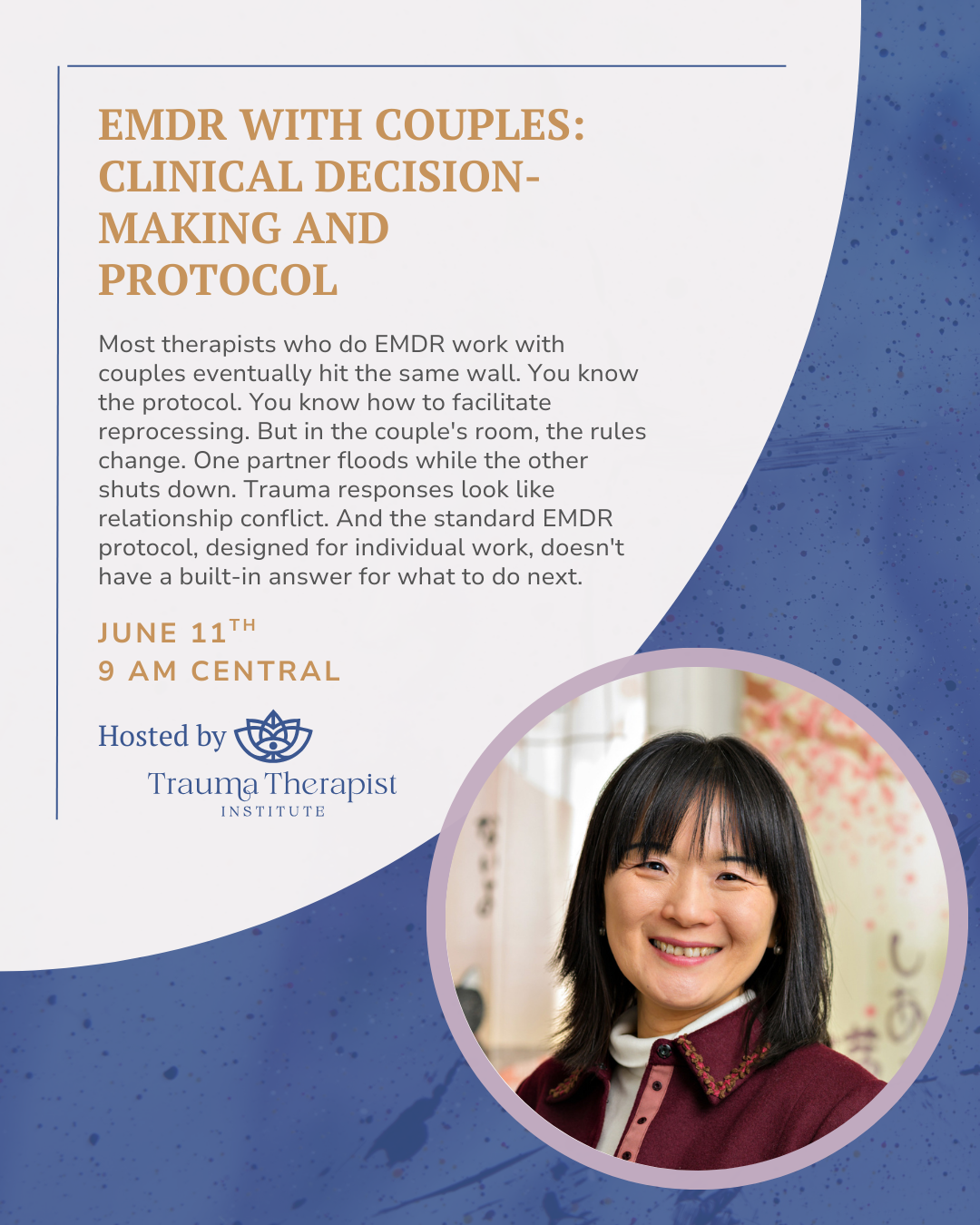
EMDR with Couples
Clinical Decision-Making and Protocol
Registration: https://www.traumatherapistinstitute.com/EMDR-with-Couples-Clinical-Decision-Making-and-Protocol
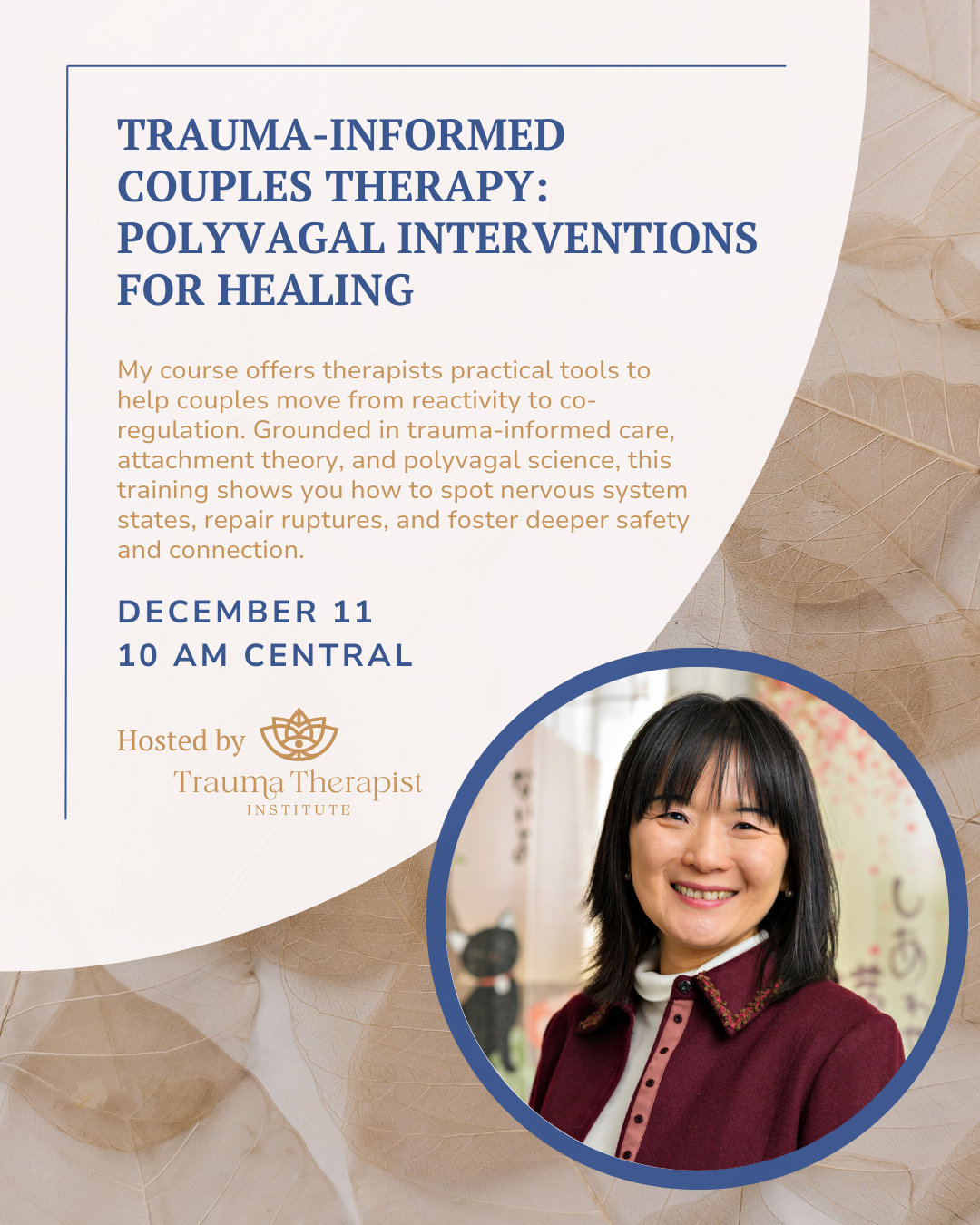
Trauma-Informed Couples Therapy: Polyvagal Interventions for Healing
When I received the email from TTI that the course would be live in early September, I had a flashback to the moment when I turned in my approved dissertation to the graduate school. I remembered a feeling of accountability and responsibility to my dissertation participants: that dissertation is the beginning to explore working with couples when one or both partners have a trauma history. I will devote the rest of my life to integrating my individual therapy and systemic therapy training to help couples with trauma history.
Then, two years later, I had to give up my academic career, and five years later, I had to end my career in community agency. I lost everything I knew how to do and had been doing. I thought that I would never be able to find my way back to what I want to do.
When one door is closed, another door opens.
I signed up for EMDR basic training immediately after I left my agency job in 2015. In the last 10 years, I continued to dive into EMDR, trauma-informed practice, and couples therapy training. I have been so fortunate to have excellent consultants who guide me through this process as I am searching for that missing piece of couple therapy and trauma healing.
Two years ago, I was reading Polyvagal Informed EMDR Therapy, and this sentence caught my attention:
“I coregulate Jane by using my own regulated nervous system to guide her through various regulating strategies and, in doing so, increase her access to her ventral circuit, expanding her window of tolerance.” (p.5, Kase, 2023).
At that moment, a light bulb went on in my head! That’s it! I have been searching for the connection between the AIP model and attachment theory. This paragraph captured the idea of secure attachment style. I believed that polyvagal theory is the link between the AIP model and attachment theory to understand couple therapy when one or both partners have a trauma history.
Then, Rebecca Kase actually offered me a spot on her team and guided me to a deeper understanding of Polyvagal Theory. I felt as if the whole Universe conspired together to help me find what I was looking for.
I dived into the literature review and the consultation, and tried it out in clinical work. And here it is, my first attempt to continue making the progress of my promise to myself 15 years ago: a clinical model helping couples when one or both partners have a trauma history. I feel so grateful that the dream didn’t get lost when my life was falling apart. Now, I get to present something I am so passionate about for the first time after 15 years.
I saw my younger self from almost 20 years ago. She was putting together her dissertation proposal. I felt such gratitude to her who planted a seed and continued to walk towards that goal.
This training is the first step after 15 years, and definitely not the last. I might still be nervous and have a lot to weave together over the next 15 years. Still, I hope you will join me and challenge me with my model so that we can continue to establish a model for couples when one or both partners have a trauma history to heal in the relationship.
This training is offered through the Trauma Therapist Institute. Please use the following link for detailed information and registration.